
Bigpicture raises the (DICOM) standards
Whole Slide Images (WSI) are digitized microscope slides that are very large in size at diagnostic resolution. WSIs can come in all kinds of formats, and each format stores the images, its metadata and the graphical annotations differently. With the aim that pathologists can easily access and zoom into the data they need without worrying about format specifics, Bigpicture selected the DICOM format as a standard for archiving WSIs. We spoke with Erik O Gabrielsson, WP4, Research Engineer at Sectra, about the implementation of the DICOM tooling developed for Bigpicture and what it means for future users.

What is DICOM?
DICOM stands for Digital Imaging and Communications in Medicine and is a standard used primarily in radiology but also becoming popular for in digital pathology. WSIs store the large resolution image as several image ‘levels’ in a pyramid shape at different resolutions (figure 1). It is built upon the idea that you only have to read a specific area of the image that you are interested in. DICOM will only focus on the resolution of the specific area of interest, making it a faster and more efficient process. Erik explains: “The pathologist will search through a slide with a relatively low resolution, which will increase once he or she zooms into selected areas of diagnostic interest. To ensure that the process is as quick and efficient as possible, the image data is stored in ‘tiles’, ensuring access to any area of the image without loading large amounts of data.”
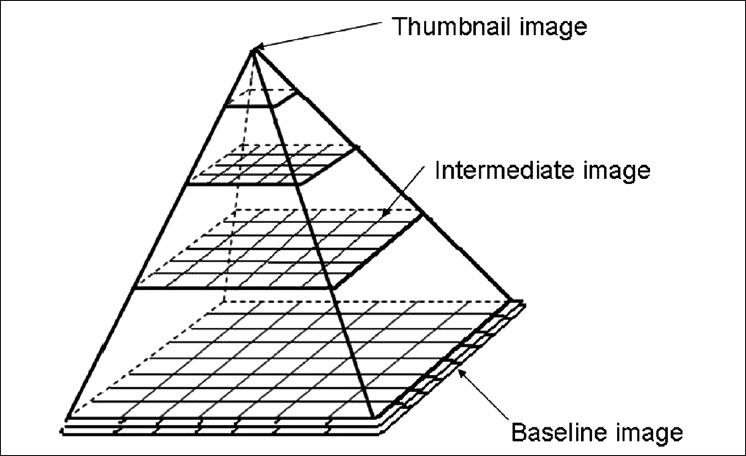
DICOM is moving towards becoming the industry standard for digital pathology. One of the big advantages of DICOM is it is an open format that everyone can use. It has growing support in the industry, and although the used format usually depends on the scanner models and manufacturers, there is already lots of scanners and software compatible with DICOM.
Converting to the DICOM standard
One of the tasks of WP4 is to create user-friendly conversion tools to convert different WSI formats to the DICOM standard. As there was a lack of open-source implementations specifically targeting DICOM WSI, WP4 started with developing a reader and writer in Python, that would also serve as the foundation for a converter. Continuing with researching the options of readers for other formats, WP4 developed a new reader for formats that were relatively easy to convert (meaning files that were stored and structured in the same pyramid-shape way as with DICOM). Erik: “The ‘easy to read’ formats are similar to the DICOM format. In these cases, we don’t have to decode or recode the image. This is beneficial because each time you decode an image it slightly degrades. Other formats can be more difficult to read, for instance due to a different compression scheme or tile organization. Fortunately for most of these formats there other readers that can be used, although at the cost of image quality and speed.”
The implementation of more formats is an ongoing process. There are many different existing formats out there, which brings us to one of the challenges for WP4; how to cover as many formats as possible in a very large landscape where new cases will constantly be discovered? Erik: “We focussed on the formats that are most commonly used by the Bigpicture partners, but we will need the feedback of (potential) users to see what specific formats are not yet being supported.”

Aperio svs
Hamamatsu ndpi
Philips tiff
OME-tiff
Zeiss czi
Mirax mirax
Leica scn
Sakura svslide
Trestle tif
Ventana bif
Olympus vsi
Upgrading the user-experience
The Bigpicture implementation of the DICOM standard has been evolving and improving since the beginning of the Bigpicture project and will continue to do so in the coming years with the performance of the speed when opening the files being a key element. Additionally the conversion of the data should be efficient and not take longer than a few minutes as users of the Bigpicture repository will upload many WSIs. Erik: “At the moment we have good tools to use, and we are working on a more user-friendly (and graphical) interface. The already existing converters were slow and would reduce the quality of the WSIs. We changed this to a – from a technical point of view – super fast converting with the same quality. We went from 4 minutes per slide to 10 seconds!”
Future perspectives
“The next step for us is to integrate the DICOM converter into the submission workflow, combining the converted images with the slide metadata”, says Erik. “The aim is that the conversion should occur in the background, invisible to the user, and ‘just work’, to produce datasets that are ready for submission to the Bigpicture repository.”
About Erik
Erik O Gabrielsson is Research Engineer at Sectra in Sweden. He is involved in Bigpicture’s WP4 and is primarily focussed on tools and data formats that we can use to upload whole slide images (WSI). Erik: “I was recruited by Sectra to work in the Bigpicture project. I previously worked as a research engineer at the university, but in a different field. But it’s the first time that I work with medical imaging and digital pathology. The biggest differences that I’ve experienced in this field is that the research for Bigpicture is more exploratory and of course it’s for a medical purpose, meaning that we need to be extra careful in the handling of the images.”
Latest updates

What does it take to turn 120,000 clinical pathology slides into data that researchers can actually use...
Read more
Being unique is one thing. Being valuable enough for organizations to rely on is another. Dr. Page...
Read more
The biggest hurdle for pathology AI may no longer be building the technology, but proving it works...
Read more